

Choosing between quartz and granite is less about finding a universal winner and more about finding the surface you will enjoy living with. Either may be attractive in a kitchen. Both can last for years with appropriate use and care. They differ in appearance, maintenance, and how much control you have over the finished design.
If you own a home in Irvine, Newport Beach, or elsewhere in Orange County, there is a second question: Will the choice still make sense if you decide to sell? A countertop can improve the way a kitchen looks and functions, but its effect on a future sale depends on the entire room, the quality of the installation, the home, and the market at the time. No slab comes with a guaranteed return.
Written by Tony Babarino, Irvine Real Estate Broker and REALTOR® with REAL Broker, serving Irvine, Newport Beach, and surrounding Orange County communities. California DRE#01717758.
Quartz and granite at a glance
| What matters | Engineered quartz | Natural granite |
|---|---|---|
| Appearance | Designed patterns and generally predictable colors | Natural variation; each slab differs |
| Routine care | Typically easy to clean; products such as Cambria need no sealing | Cleaning is straightforward; sealing depends on the slab |
| Heat | Use hot pads or trivets | Use hot pads or trivets |
| Stains | Stain-resistant, not stain-proof | Resistance varies; some slabs benefit from sealing |
| Chips and scratches | Possible, especially at exposed edges | Possible, especially at exposed edges |
| Selection | Review the specific product and proposed layout | Inspect the actual slabs and proposed layout |
| Outdoors | Check manufacturer approval; many are not UV-suitable | Check the stone, finish, and installation with the supplier |
These are starting points, not performance guarantees. The exact product, finish, fabrication, installation, and manufacturer instructions matter. For example, Cambria’s product-care guidance recommends protection from hot cookware and confirms that its product does not need sealing. The Natural Stone Institute explains that many natural stones do not require sealing and recommends trivets even though many stones tolerate heat.
The Difference You Will See Every Day
Granite is natural stone. Its mineral pattern, color movement, and small variations are part of its appeal. One slab might be quiet and consistent; another might have dramatic movement that becomes the focal point of the kitchen. If that individuality is what you love, inspect the actual slabs before you buy. A small sample cannot show how a vein, darker patch, or change in pattern will cross an island or turn a corner.
Quartz is an engineered countertop surface. Manufacturers offer a broad range of colors and patterns, from restrained, nearly solid looks to designs intended to resemble natural stone. That predictability can make it easier to coordinate a countertop with cabinets, flooring, backsplash, and paint. “Quartz” in this article means an engineered surface; it is different from natural quartzite.
Neither category has a single look. A lightly patterned granite may feel quieter than a boldly veined quartz. A carefully selected granite might fit a contemporary kitchen, while a warm-toned quartz might suit a traditional one. Bring cabinet and floor samples to the showroom and view the countertop material under lighting similar to your own kitchen’s. Look at a large display or full slab whenever possible.
If you want to compare quartz and granite with porcelain, quartzite, soapstone, or newer mineral surfaces, my guide to additional countertop options discusses porcelain, quartzite, soapstone, and other alternatives.
How Much Maintenance Are You Willing to Take On?
Quartz is attractive to homeowners who want a straightforward routine. For example, Cambria recommends warm water, a soft cloth, and mild soap if desired. Its nonabsorbent surface does not require routine sealing. That does not mean every spill can be ignored indefinitely or that every cleaner is suitable for every brand. Keep the care instructions for the exact product you purchase.
Granite care is often described as an annual sealing chore. That is too broad. According to the Natural Stone Institute’s care guidance, many stones may not need sealing; a sealer, when appropriate, improves stain resistance rather than making a surface stain-proof. Ask the stone supplier whether your selected slab should be sealed, what treatment it has already received, and how to assess its condition over time.
For day-to-day granite cleaning, the Natural Stone Institute recommends a suitable neutral cleaner, stone soap, or mild dishwashing detergent and warm water. Follow the guidance for your slab and finish, particularly before using stronger cleaners. A polished, honed, or textured finish can change both the appearance and the way marks show.
Here is the practical test: Would the care routine still feel reasonable on a busy Tuesday, several years after the renovation? Choose for that kitchen, not only for the showroom.
Heat, Scratches, Chips, and Stains: Avoid the Absolute Claims
You may hear that granite can take any hot pan or that quartz cannot handle a working kitchen. Neither statement is a good operating rule.
Quartz manufacturers commonly advise using a trivet beneath hot cookware and appliances. Cambria specifically mentions pots, pans, air fryers, slow cookers, and other equipment that can transfer sustained heat. The Natural Stone Institute also recommends trivets for natural stone, even though many stones can withstand heat. Using one is an easy habit with either material.
Both surfaces resist ordinary wear, but neither is a cutting board or a place to strike heavy cookware against an exposed edge. Chips can occur near sinks, dishwashers, and other heavily used edges. Stain resistance also varies. Quartz products are generally nonabsorbent, while natural granite varies by slab and treatment; neither description means a countertop is impossible to mark or damage.
When you compare samples, ask the supplier about the specific finish and color. A dark, uniform surface may reveal crumbs, dust, fingerprints, or certain marks differently from a busier pattern. That is an appearance consideration, not proof that one material is more durable.
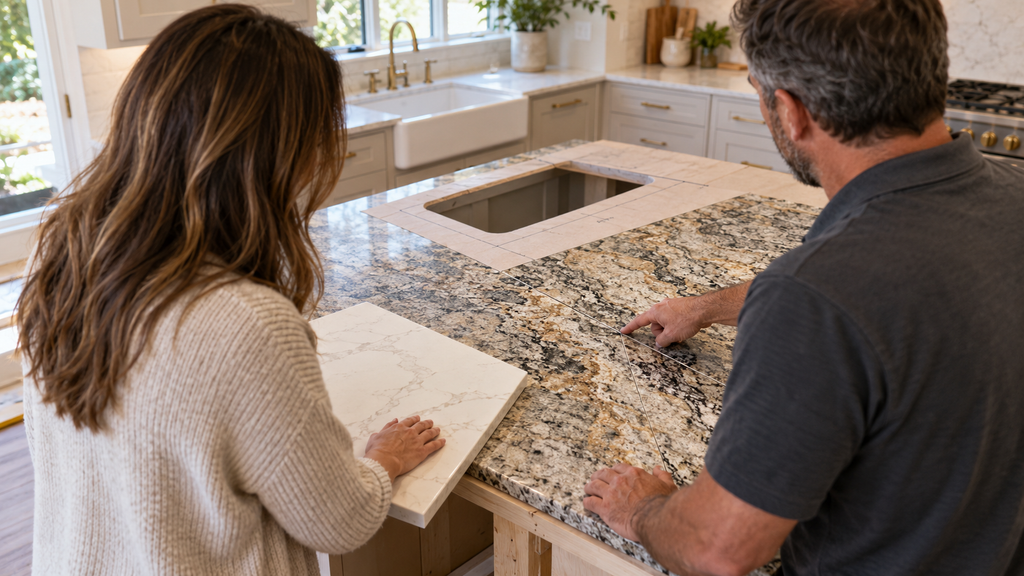
The Installation May Matter as Much as the Material
A beautiful slab can disappoint if the planning is weak. Before you authorize fabrication, ask to see how the material will be laid out in your kitchen. Discuss:
- Where seams will fall and how visible they may be.
- Which parts of a natural granite slab will appear on the island and perimeter.
- Whether a quartz pattern will align acceptably across seams, corners, or a waterfall edge.
- The edge profile and how it will look beside the cabinetry.
- Sink and cooktop openings, nearby edges, and areas that may need support.
- How the countertop meets the backsplash, wall, and appliances.
- What is included in removal, plumbing reconnection, and finishing work.
Have the fabricator or appropriate qualified professional determine technical requirements for supports, overhangs, cutouts, and the installation. Get the material identification, finish, scope, seam plan, and applicable warranties in writing. Compare complete proposals rather than assuming two quoted prices cover the same work.
For an Orange County project, you can check a contractor’s license through California’s Contractors State License Board and review its home improvement contract guidance before signing.
Ask About Fabrication Dust, Too
The main silica health issue associated with stone countertops concerns respirable dust created while materials are cut, ground, polished, or installed, particularly for workers. It should not be confused with simply living with an intact, installed countertop. A February 2026 OSHA/NIOSH hazard alert addresses fabrication and installation of both natural and engineered stone.
If work is planned at your home, ask who will do the cutting, where it will occur, and how dust will be controlled; leave the technical safety measures to responsible professionals. California is also considering tighter restrictions on some high-silica engineered-stone fabrication. Because that process is changing, verify the current rule before ordering, rather than assuming that a proposed ban is already in effect.
What if the Kitchen Gets Strong Sun or Includes an Outdoor Area?
Check the exact product before carrying an indoor countertop choice onto a patio or into a kitchen with substantial direct exposure. Cosentino states that Silestone is not recommended outdoors because UV exposure can damage its surface. Other products have their own specifications.
Do not assume that every material sold as “quartz” has identical limits, or that every granite slab and installation is suitable outside. Ask for written product guidance for the proposed location.
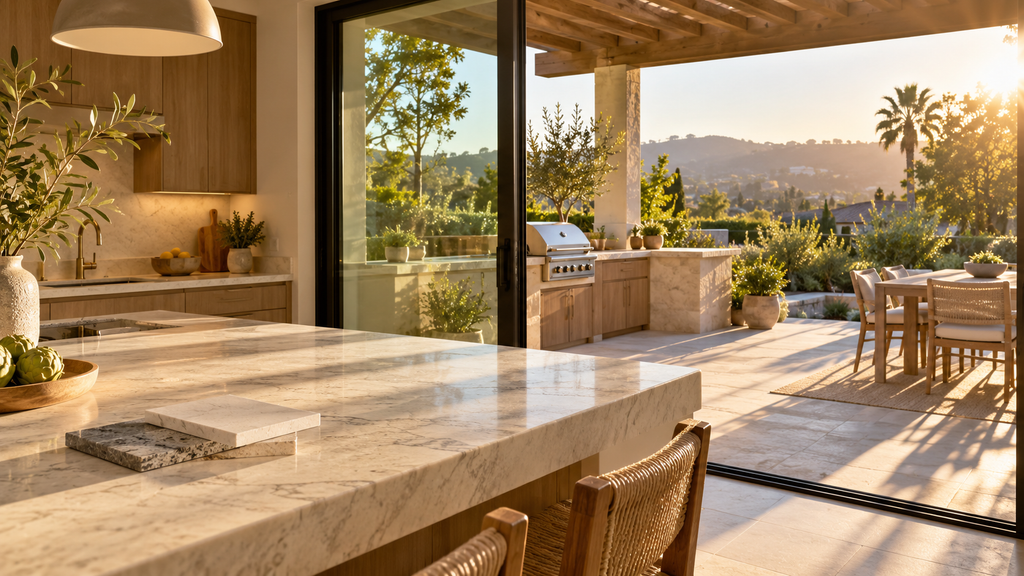
Will Quartz or Granite Help When You Sell?
Buyers experience a whole kitchen. They see how the counters work with the cabinets, backsplash, lighting, flooring, appliances, and the rest of the home. An expensive slab will not automatically overcome worn cabinets, awkward details, or poor installation. Conversely, an existing countertop in good condition may be entirely appropriate to keep.
That matters if you are updating your home now but might sell in a few years. Choose a design you will enjoy, while considering whether it feels coherent with the home.
In an Irvine kitchen with warm cabinetry and flooring, for instance, compare samples in that setting before ordering a cool-toned surface because it looked attractive in a bright showroom. In a Newport Beach kitchen with large windows, consider how the slab and finish appear at different times of day. Those are design checks, not rules that one neighborhood or buyer “requires” a particular material.
The 2025 NAR/NARI Remodeling Impact Report found high homeowner satisfaction with kitchen upgrades and reported increased demand for them among surveyed real estate professionals. It did not establish that selecting quartz instead of granite produces a particular sale price, selling time, or countertop-specific return. Personal enjoyment and cost recovery are separate questions.
If selling is close, pause before ordering new counters solely for resale. Depending on the kitchen, improving lighting, repairing an obvious defect, cleaning or refreshing grout, updating hardware, or presenting the existing space well may be a better use of the budget.
A property-specific look at competing homes and your kitchen’s current condition is more useful than a blanket instruction to install quartz or granite. My approach to preparing and marketing an Irvine or Orange County home starts with that broader view.
A Showroom Checklist Before You Commit
Take photos of your kitchen in daylight and at night. Bring samples or clear photos of the cabinets, flooring, backsplash, and hardware. Then get answers to these questions:
- What is the exact product or stone? Record the brand, color, finish, slab identification where relevant, and written care information.
- Am I seeing the material I will receive? For granite, inspect the actual slabs. For patterned quartz, ask how the installed layout may differ from a sample or display.
- What does the complete price include? Confirm templating, fabrication, edge work, removal, sink and cooktop openings, installation, plumbing coordination, and any other work.
- Where will the seams go? Review their proposed locations before fabrication.
- What happens if an edge chips or a seam needs attention? Ask who handles service and what the product and installation warranties cover.
- What care will this surface require in my home? Get the instructions for the chosen product and finish rather than relying on general claims about “quartz” or “granite.”
- Does the choice work with the whole room? View it beside your actual finishes and consider how it will feel to live with, clean, and eventually show to buyers.
The final decision is often clearer after these questions than after reading another list of generic pros and cons.
So, Which Should You Choose?
Choose quartz if you prefer its particular designs, want predictable coordination with the room, and value a surface that generally does not require sealing.
Choose granite if you love the actual natural slabs you have found and are comfortable following the care recommendations for that stone and finish.
Either can be a thoughtful choice for an Irvine or Orange County home. Select it for your daily life first, insist on careful planning and installation, and treat possible resale appeal as one consideration rather than a promised payoff.
A countertop may influence how a home photographs and how a buyer experiences its kitchen, but it is only one part of the property’s presentation. When you’re thinking about selling, I can help evaluate whether replacing counters makes sense alongside the other improvements competing for your budget.
If you are considering changes partly because you may sell, I can help you look at the kitchen through a buyer’s eyes before you commit to a renovation. Sometimes the countertop is the right project. Sometimes another improvement deserves attention first.
As an Irvine Real Estate Broker and REALTOR® serving Irvine and surrounding Orange County communities, I use modern marketing methods, including custom video and social media reach, to help my sellers’ homes attract more attention.
Rather than relying only on buyers finding your listing, I work to put your home in front of potential buyers where they’re already spending time: on social media, watching videos, and browsing online from their phones, tablets, televisions, and computers. This includes people who may be considering a move but haven’t started actively searching for a home.
Sometimes, seeing the right home at the right time is enough to turn someone’s curiosity into genuine interest.
I don’t just wait for buyers to find your home. I help potential buyers discover it.
Tony Babarino, Irvine Real Estate Broker and REALTOR®
with REAL Broker
Serving Irvine, Newport Beach, and surrounding Orange County communities.
California DRE#01717758
Call/Text: (949) 633-6741

Disclaimer: This article is for general homeowner and real estate education, not construction, medical, legal, or other professional advice. Countertop performance, care, fabrication, and installation depend on the specific product and project. Consult manufacturers, suppliers, and appropriately qualified professionals. Fabrication of materials containing crystalline silica can expose workers to hazardous dust; workplace-safety requirements and California regulations may change. This article is not intended as a solicitation of homeowners already represented by another real estate broker.
Want more Irvine real estate insights, helpful homeowner tips, and original videos in your Google experience? Add TonyBabarino.com as a Preferred Source.