
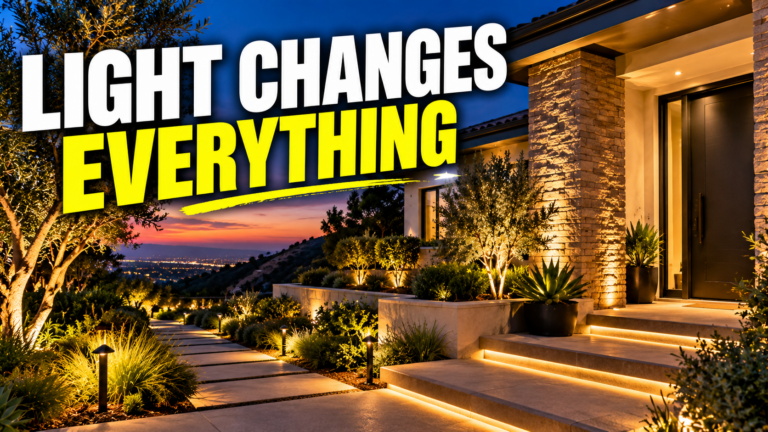
What if one of the most noticeable improvements you could make to your home after sunset had nothing to do with remodeling the kitchen, replacing the flooring, or redesigning the backyard?
Sometimes it is simply better outdoor lighting.
Thoughtfully placed exterior lighting can change the way a home looks and feels after dark. It can make the front entrance more welcoming, help people navigate walkways and steps, extend the usefulness of patios and outdoor living areas, and bring attention to landscaping or architectural features that almost disappear at night.
For homeowners in Irvine, Newport Beach, Newport Coast, and throughout Orange County, that can matter whether you plan to stay in your home for years or are starting to think about selling.
Outdoor lighting is not about making the property brighter.
In many cases, better lighting actually means using less light, in better locations, for a specific purpose.
Written by Tony Babarino, California Real Estate Broker and REALTOR® with REAL Broker, serving Irvine, Newport Beach, Newport Coast, and surrounding Orange County communities. DRE#01717758.
Key Takeaways
- Start with function before decoration: entries, walkways, stairs, gates, and outdoor living areas.
- More light is not necessarily better. Direction, brightness, glare, and placement matter.
- Layering ambient, task, pathway, and accent lighting can create a more comfortable outdoor environment.
- Timers, motion sensors, photocells, and smart controls can make exterior lighting easier to manage.
- Before changing permanently installed lighting, homeowners should consider HOA requirements, electrical conditions, applicable codes, and whether a qualified professional should be involved.
- Sellers do not necessarily need an expensive landscape-lighting system. Sometimes correcting a few obvious lighting problems can noticeably improve nighttime presentation.
Why Outdoor Lighting Changes the Way a Home Feels
Walk through your house during the day and then walk around the same property after sunset.
It can almost feel like two different homes.
During daylight, you notice landscaping, trees, pathways, exterior finishes, patios, stonework, architectural details, and the way different parts of the property connect.
After sunset, most of those features disappear unless lighting brings some of them back.
Now imagine approaching two similar homes at night.
The first has one extremely bright garage fixture, a dim porch bulb, and dark pathways leading toward the front door.
The second has a comfortably illuminated entry, subtle pathway lighting, and a few carefully positioned lights highlighting landscaping or architectural features.
Neither home necessarily has more expensive landscaping.
But they can feel very different.
That is why good outdoor lighting is less about the fixtures themselves and more about what the lighting allows you to see, use, and experience.
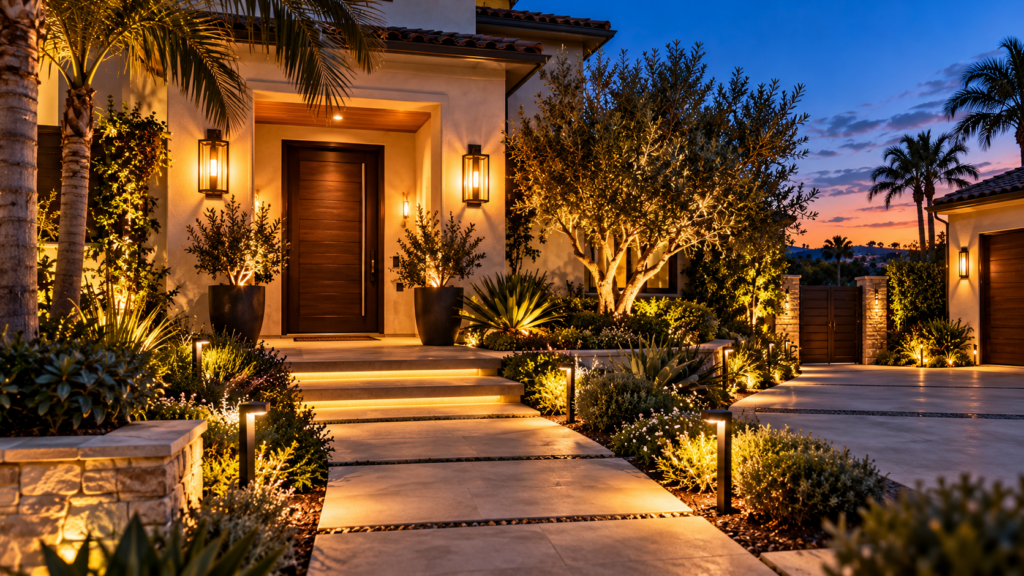
1. Start With the Front Entrance
If you are unsure where to begin, start where people arrive.
Your front entrance establishes the transition from the street or driveway into the home.
Look at:
- The front door
- Porch
- House numbers
- Walkway
- Steps
- Driveway-to-entry route
- Gate, if applicable
You generally want enough illumination for people to comfortably find and approach the entrance without creating harsh glare.
This is also an area where homeowners sometimes overdo it. Extremely bright bulbs aimed outward can make it harder—not easier—to see comfortably because the eye is constantly adjusting between bright light and darkness.
Instead, think about creating an inviting visual path toward the door.
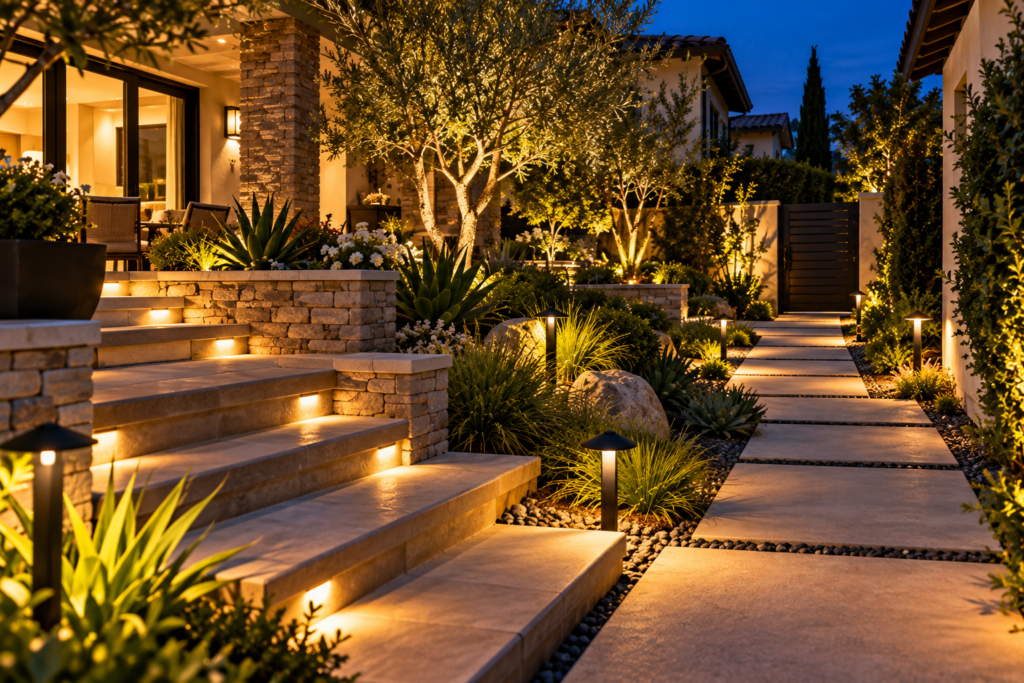
2. Look at Walkways, Steps, and Changes in Elevation
Outdoor lighting becomes especially important where people move from one elevation or surface to another.
Walk around your property after dark and look for:
- Steps
- Raised patios
- Changes between concrete and grass
- Garden borders
- Side-yard pathways
- Deck stairs
- Changes in elevation
- Gates or narrow passageways
The objective is not to flood every surface with light.
Low-level pathway, step, or nearby lighting may help make these transitions easier to identify while keeping the overall setting comfortable.
If an area raises an actual safety, electrical, construction, or accessibility concern, lighting should not be treated as a substitute for correcting the underlying condition. A qualified professional may need to evaluate it.
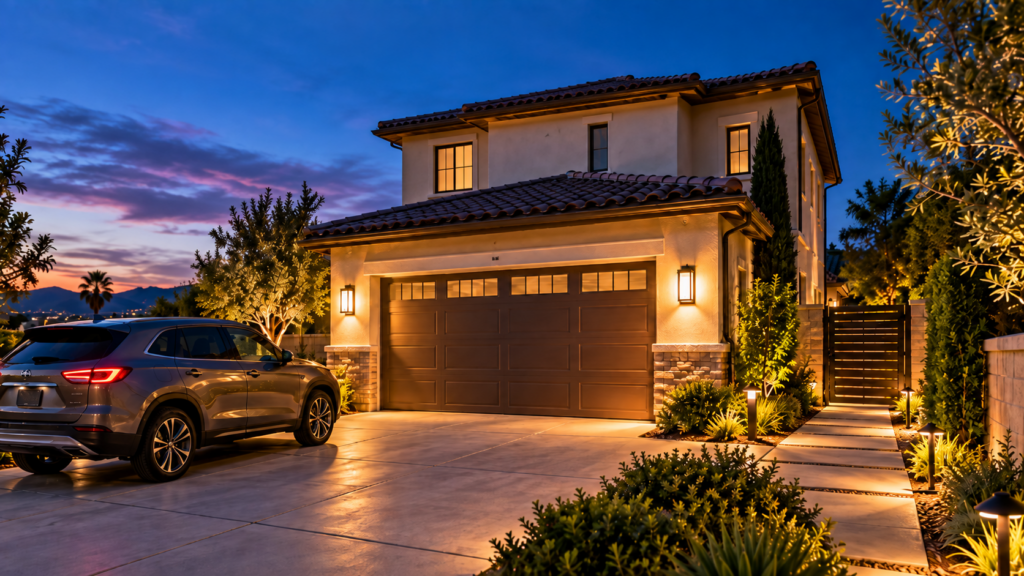
3. Do Not Forget the Driveway, Garage, and Side Yard
Homeowners often concentrate on the front door and backyard while overlooking the areas they use every day.
That includes the driveway, garage entrance, trash-bin area, and side yards.
Think about the way you actually use your property:
Where do you unload groceries?
Which gate do you use?
Where do you walk when taking trash containers out at night?
Where do family members enter the home after parking?
Where are exterior storage areas located?
Lighting these areas can be much more useful in everyday life than installing decorative lighting somewhere that is rarely used.
Motion-activated lighting may be worth considering in some locations because it provides illumination when needed without necessarily leaving the area brightly lit throughout the night.
4. Use Landscape Lighting to Create Depth
Landscape lighting is where outdoor lighting starts becoming more visual.
Instead of illuminating the entire yard evenly, consider whether there are a few features worth emphasizing.
For example:
- A mature tree
- Palm trees
- Sculptural plants
- A garden wall
- Stonework
- An interesting architectural surface
- A fountain or water feature
- Columns
- A courtyard
- A specimen plant or focal point
A carefully positioned light can create shadows, texture, and depth that you simply do not see during daylight.
The key word is carefully.
Several extremely bright spotlights aimed at everything in the yard can flatten the scene rather than enhance it.
A better approach is usually selective.
Allow some areas to remain darker so the features you choose to illuminate actually stand out.
5. Think in Layers Instead of Using One Type of Light
Some of the most comfortable outdoor environments use several different types of lighting rather than repeating the same fixture everywhere.
Think about four basic layers:
Ambient lighting
Provides general illumination for an outdoor living area.
Task lighting
Adds light where a particular activity takes place, such as an outdoor kitchen, grill, serving counter, or dining area.
Path and step lighting
Helps define circulation areas and elevation changes.
Accent lighting
Highlights landscaping, architecture, walls, trees, or other focal points.
You do not necessarily need all four everywhere.
The idea is simply to ask:
What is this light supposed to accomplish?
If there is no good answer, you may not need the fixture.
6. Make Patios and Outdoor Living Areas Usable After Sunset
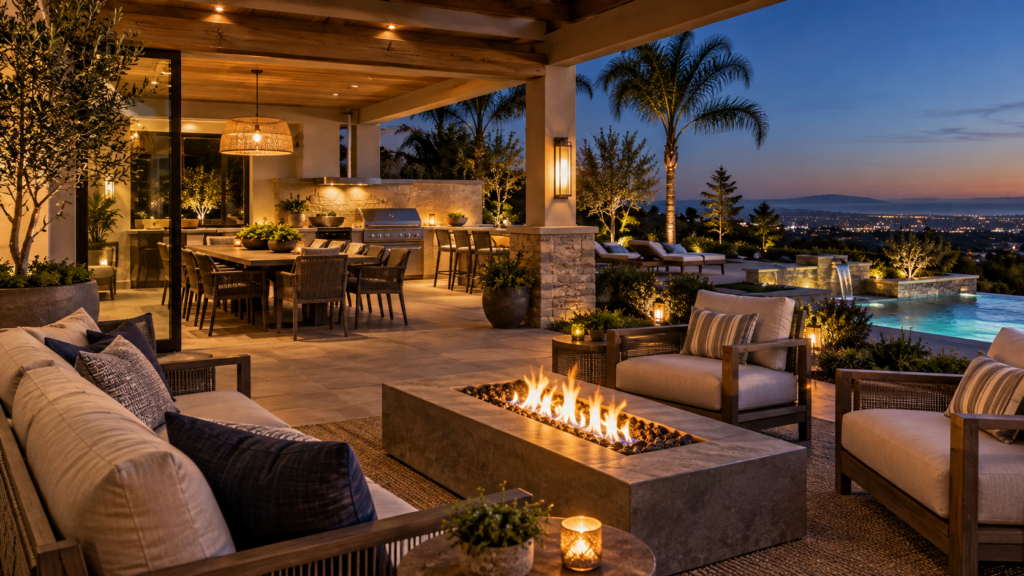
In Southern California, a patio, courtyard, balcony, or backyard can function almost like another room of the house.
But when the only outdoor light is a powerful floodlight attached to the rear wall, the space may be technically illuminated without feeling very inviting.
Consider how the area is actually used.
Is there a dining table?
Outdoor kitchen?
Conversation area?
Pool?
Fire feature?
Covered patio?
Sitting wall?
Different activities may benefit from different lighting.
A dining table might benefit from soft ambient illumination. Food preparation may require more focused task lighting. Landscaping surrounding the patio may look better with subtle accent lighting.
For homeowners interested specifically in overhead string or café-style lighting, I have a separate article on bistro lighting for outdoor living spaces because hanging, spacing, supporting, and planning that style of lighting deserves its own discussion.
7. Pay Attention to Brightness, Glare, and Light Direction
One of the biggest outdoor-lighting mistakes is assuming brighter automatically means better.
It does not.
Responsible outdoor-lighting guidance generally emphasizes using light where it is needed, directing it toward its intended area, avoiding unnecessary brightness, using controls, and favoring warmer-colored light where appropriate.
That makes sense from a design standpoint as well.
A fixture shining directly into someone’s eyes can be uncomfortable even if the surrounding area is technically well illuminated.
Light spilling into a bedroom window or neighboring property can also create problems that were never intended.
When evaluating your lighting, stand in several places:
- On the sidewalk
- At the front door
- Inside rooms looking toward the exterior
- On the patio
- At neighboring property lines where appropriate
- At different points along the walkway
Sometimes the problem is not the amount of light.
It is simply where the fixture is pointing.
8. Warm Light Can Feel Very Different From Cool Light
Color temperature can dramatically change the appearance of a property.
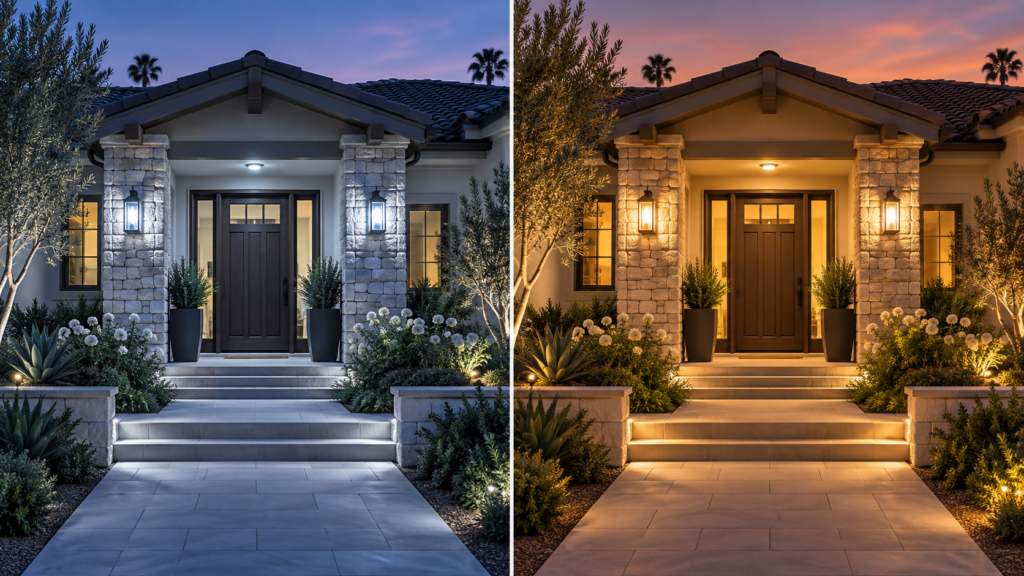
Warmer residential lighting often creates a softer, more relaxed appearance, while very cool or blue-white lighting can appear sharper or more institutional depending on the fixture, surface, and environment.
There is no single bulb temperature that is automatically correct for every home.
Exterior paint colors, stone, landscaping, fixture design, brightness, and surrounding ambient light all affect the result.
Instead of replacing every bulb at once, consider testing one or two fixtures first.
Then step back and look at the house from the street.
Sometimes a small difference in color or brightness changes the entire appearance of the entry.
9. Use Controls So the Lighting Works Without Constant Attention
Outdoor lighting becomes much easier to live with when homeowners do not have to remember every switch every evening.
Depending on the installation, options may include:
- Timers
- Motion sensors
- Photocells
- Astronomical timers
- Dimmers
- Smart switches
- App-based controls
- Lighting scenes
A homeowner might want one lighting setting for arriving home, another for entertaining, and a lower level later in the evening.
Automation can also help prevent unnecessary lighting from remaining on simply because somebody forgot to turn it off.
Permanently installed residential outdoor lighting may be subject to current California energy, electrical, building, or local requirements depending on the project. Homeowners considering electrical alterations should verify what applies to their specific property and use an appropriately qualified professional when necessary.
10. Consider the Neighbors Too
Outdoor lighting does not stop being visible at your property line.
A beautifully illuminated backyard for one homeowner can become unwanted light entering another homeowner’s bedroom.
Before installing or repositioning powerful fixtures, look at where the beam actually travels.
Good lighting generally keeps illumination focused on the area where it serves a purpose.
Shielding, fixture position, beam direction, brightness, and controls may all help reduce unnecessary spill.
This becomes particularly important in neighborhoods where homes are close together.
What About Solar Outdoor Lights?
Solar lighting can be useful in certain situations, particularly where homeowners want a relatively simple product that does not require extending household electrical wiring.
But results vary considerably.
The amount of sunlight available to the solar panel, product quality, battery condition, fixture output, placement, landscaping, and seasonal conditions can all affect performance.
Think of solar lighting as one option rather than automatically assuming it is the best solution for every location.
If reliable illumination is important for a particular area, evaluate the actual performance of the product rather than choosing it solely because it is solar powered.
Common Outdoor Lighting Mistakes
Some outdoor-lighting problems are surprisingly easy to spot once you intentionally look for them.
Watch for:
- Using fixtures that are much brighter than necessary.
- Mixing dramatically different bulb colors around the same area.
- Aiming lights into windows or neighboring properties.
- Lighting decorative landscaping while leaving important walking areas difficult to see.
- Using too many different fixture styles.
- Ignoring dirty, corroded, tilted, or damaged fixtures.
- Allowing landscaping to grow over pathway or accent lights.
- Leaving burned-out bulbs in prominent locations.
- Installing outdoor lighting without checking applicable HOA or property restrictions.
- Treating electrical installation as a DIY project when professional electrical work may be appropriate.
Sometimes improving a lighting plan means adding fixtures.
Other times it means removing, redirecting, dimming, cleaning, or replacing what is already there.
Outdoor lighting is also worth including in your seasonal home-maintenance routine, along with checking exterior fixtures, bulbs, timers, landscaping, and other areas around the property.
Thinking About Selling? Walk Your Home at Night
Most sellers prepare their homes during the daytime.
That makes sense.
But before your home goes on the market, I recommend something else:
Walk around the property after sunset.
Do not walk it as the homeowner who already knows where everything is.
Try to look at it as someone arriving for the first time.
Ask yourself:
- Can I easily identify the front entrance?
- Does the entry feel welcoming?
- Can I see changes in elevation?
- Are any bulbs burned out?
- Are fixtures dirty or obviously dated?
- Does one fixture overpower everything else?
- Do bulb colors clash?
- Does the landscaping disappear completely?
- Does the backyard still feel like usable living space?
- Are there features worth highlighting?
- Would the exterior look good in twilight photography or video?
You may discover things at night that you never notice during the day.
Outdoor Lighting and Selling Your Home
Outdoor lighting should not be viewed as a guaranteed way to increase a home’s value or sale price.
Real estate does not work that neatly.
A property’s value depends on many factors, including location, condition, size, floor plan, upgrades, lot, comparable sales, competing inventory, market conditions, pricing, and buyer demand.
But presentation matters.
Buyers experience a home visually and emotionally.
A comfortable entry can feel inviting.
A softly illuminated patio can help buyers understand how the outdoor space might be used.
Landscape lighting can bring attention to mature trees, hardscape, walls, or architectural details that otherwise disappear after sunset.
And good exterior lighting can help photography and video communicate parts of the property that may be difficult to appreciate after dark.
That does not mean I would automatically recommend that a seller spend thousands of dollars installing a new landscape-lighting system.
The first question should be:
What already exists, and what actually needs attention?
Replacing a few mismatched bulbs, cleaning fixtures, correcting an overly bright floodlight, repairing a nonworking fixture, trimming landscaping away from existing lights, or improving the appearance of the front entrance may be more appropriate than undertaking an expensive project immediately before selling.
The objective is not to spend money simply because the house is going on the market.
It is to determine which changes, if any, may improve the way buyers experience the property.
A Simple Nighttime Outdoor-Lighting Checklist
Walk around your property after dark and check:
- Front-door visibility
- House-number visibility
- Driveway
- Walkways
- Steps
- Side gates
- Side yards
- Garage access
- Patio
- Outdoor dining area
- Outdoor kitchen
- Landscaping
- Trees
- Architectural features
- Burned-out bulbs
- Mismatched bulb colors
- Glare
- Light entering windows
- Light spilling toward neighboring properties
- Dirty or damaged fixtures
- Timers or controls
- Areas where lighting may be unnecessary
Take a few photographs with your phone while doing this.
Photographs sometimes reveal uneven lighting, glare, dark areas, or color differences that are less obvious while you are standing there.
Final Thoughts
The secret power of outdoor lighting is not really the light itself.
It is what the light reveals.
A front entrance that feels welcoming.
A walkway that makes sense after dark.
A tree that becomes a focal point.
A patio that still feels like part of the home after sunset.
A backyard that invites you to stay outside a little longer.
Good outdoor lighting does not need to shout.
In fact, some of the best lighting is almost invisible because you notice the home—not the fixture creating the light.
If you are thinking about selling a home in Irvine, Newport Beach, Newport Coast, or surrounding Orange County communities, I can walk through the property with you and help look at it from a buyer’s perspective.
Sometimes preparing a home for sale means making improvements.
Sometimes it means deciding not to make improvements that are unlikely to matter enough to justify the expense.
That conversation should happen before money is spent.
Tony Babarino
California Real Estate Broker | REALTOR®
REAL Broker
California DRE#01717758
TonyBabarino.com
Call/Text: (949) 633-6741

Frequently Asked Questions About Outdoor Lighting
Does outdoor lighting increase home value?
Outdoor lighting should not be considered a guaranteed way to increase a home’s value or selling price. Thoughtful lighting may improve nighttime presentation, outdoor usability, and the way certain features of a property are perceived, but value depends on many different property and market factors.
What outdoor lighting should homeowners consider first?
Start with areas people actually use: the front entrance, walkways, steps, driveway, garage access, gates, side yards, and outdoor living spaces. Decorative landscape lighting can be considered after functional needs have been evaluated.
Is brighter outdoor lighting safer?
Not necessarily. More brightness is not automatically better. Excessive brightness or glare may actually make an outdoor area uncomfortable to see. Lighting should be appropriate for the location and purpose, and actual safety concerns should be evaluated by the appropriate qualified professional.
Should outdoor lights be warm white or daylight?
Many homeowners prefer warmer light for residential exterior areas because it can create a softer appearance, but there is no universal setting appropriate for every property. Fixture design, brightness, exterior colors, landscaping, and the purpose of the light all matter.
Are motion-activated outdoor lights a good idea?
They can be useful in certain locations such as driveways, side yards, garages, gates, or service areas. The appropriate placement and settings depend on how the property is used and the specific equipment.
Can I install outdoor lighting myself?
Some products are designed for straightforward homeowner installation, while permanent electrical work may require permits, code compliance, or a qualified electrician depending on the project. Always follow manufacturer requirements and check what applies to your property before performing electrical work.
Do Irvine or Newport Beach homeowners need HOA approval for outdoor lighting?
Possibly. HOA requirements vary by community and property. Exterior fixture changes, visible wiring, mounting locations, architectural modifications, or other exterior alterations may be subject to association rules. Review the governing documents or contact the applicable association before making changes when appropriate.
Should sellers install new outdoor lighting before listing?
Not automatically. Start by evaluating what is already installed. Cleaning fixtures, replacing failed or mismatched bulbs, correcting obvious glare, repairing damaged fixtures, or improving a poorly illuminated entry may sometimes make more sense than installing an entirely new system.
Disclaimer: This article is provided for general educational and real-estate-related informational purposes only. It is not electrical, construction, engineering, architectural, building-code, safety, legal, tax, financial, insurance, HOA, or other professional advice.
Electrical systems, outdoor lighting requirements, permits, building and energy codes, HOA restrictions, product specifications, property conditions, and installation requirements can vary by property, jurisdiction, project, and over time. Consult the appropriate licensed contractor, electrician, building department, HOA, manufacturer, or other qualified professional regarding your particular property and proposed work.
No improvement, repair, lighting project, marketing strategy, or property-preparation decision can guarantee an increase in property value, buyer interest, sale price, or selling outcome.
If your property is currently listed for sale or you are already represented by another real estate broker, this article is not intended as a solicitation of that listing or brokerage relationship.
Want more Irvine real estate insights, helpful homeowner tips, and original videos in your Google experience? Add TonyBabarino.com as a Preferred Source.