
When a water heater fails, a dishwasher stops working, or a pipe damages the floor, homeowners often ask the same question: Is this an insurance problem, a home-warranty problem, or neither?
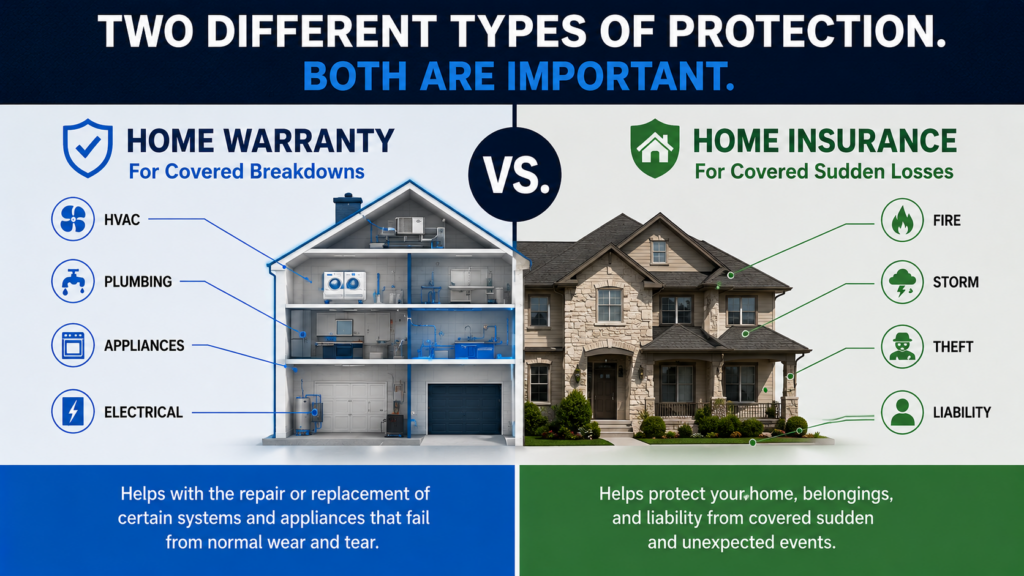
Homeowners insurance and home warranties serve different purposes, and understanding those differences can help homeowners know which type of protection may apply when something goes wrong. Homeowners insurance may help with covered losses involving the dwelling, personal property, liability, and certain sudden events. A home warranty—called a home protection contract under California law—is a separate service contract that may help repair or replace certain covered home systems or appliances.
They are not interchangeable, and neither should be treated as automatic coverage. The actual insurance policy or home protection contract controls.
Written by Tony Babarino, Irvine Real Estate Broker with REAL Broker, serving Irvine, Newport Beach, and surrounding Orange County communities. DRE#01717758.
For homeowners in Irvine, Newport Beach, and surrounding Orange County communities, the distinction can matter during normal ownership and during a sale. Buyers may ask about the condition of major systems, prior losses, and insurance availability, while sellers should not confuse a warranty offer with the property’s actual condition or disclosure obligations.
Key Takeaways
- Homeowners insurance and a home warranty serve different purposes and do not replace each other.
- California calls home warranties “home protection contracts,” and home protection companies are licensed and regulated by the California Department of Insurance.
- Coverage depends on the actual documents, including exclusions, deductibles or service fees, limits, endorsements, and the cause of the loss or failure.
- Standard homeowners insurance should not be assumed to cover flood, earthquake, wear and tear, or ordinary maintenance. Separate coverage may be needed for certain risks.
- For buyers and sellers, the condition of the home still matters. A home warranty is not a substitute for inspections, disclosures, maintenance, repairs, or insurance review.
8 Things to Compare Between a Home Warranty and Homeowners Insurance
Before relying on homeowners insurance or a home warranty, compare these eight coverage, cost, and service details in the actual policy or contract.
- What caused the loss, breakdown, or failure
- Whether the loss, system, or appliance is specifically covered
- The exclusions and limitations in the insurance policy or home warranty contract
- Insurance deductibles, home warranty service-call fees, and other out-of-pocket costs
- Coverage caps or repair and replacement limits
- Who selects or authorizes the repair contractor
- Whether separate earthquake, flood, or other coverage is needed
- What the homeowners insurance policy or home warranty contract actually says
How These Eight Differences Affect the Answer
The comparison below shows why the same household problem can produce a different answer depending on the cause, the document involved, and the limits that apply.
| What to Compare | Homeowners Insurance | Home Warranty / Home Protection Contract |
|---|---|---|
| 1. Cause of the problem | Often focuses on whether a covered peril caused a loss | Often focuses on whether a covered system or appliance failed in a covered way |
| 2. Is it specifically covered? | Depends on the policy, endorsements, and type of loss | Depends on the systems, appliances, parts, and failures listed in the contract |
| 3. Exclusions and limitations | Policy exclusions may remove or limit coverage | Contract exclusions, conditions, and service limitations may apply |
| 4. Out-of-pocket cost | Deductibles and other policy terms may apply | Service-call fees and other charges may apply |
| 5. Coverage limits | Policy limits and sublimits may apply | Repair, replacement, or dollar caps may apply |
| 6. Repair contractor | Claim and repair procedures depend on the insurer and policy | The company may control or authorize the service provider under the contract |
| 7. Separate protection | Flood and earthquake generally require separate protection | A home warranty does not replace flood, earthquake, or homeowners insurance |
| 8. Controlling document | The insurance policy controls | The home protection contract controls |
What Is Homeowners Insurance Designed to Do?
Homeowners insurance is generally designed to address covered property losses and liability risks rather than ordinary deterioration or routine appliance failure. The California Department of Insurance says coverage can include the dwelling, personal property, additional living expenses, and personal liability, depending on the policy. Homeowners should compare coverage, conditions, and exclusions rather than assume every policy is the same. (California Department of Insurance — Residential Insurance Guide)
California does not require a homeowner to carry homeowners insurance simply because the person owns a home. If the property has a mortgage, however, the mortgage servicer will generally require sufficient homeowners insurance. (California Department of Insurance — Homeowners Insurance)
Whether homeowners insurance covers a particular loss often depends on what caused the damage and the terms of the policy. California’s current residential insurance guide lists fire, theft, wind, and certain sudden and accidental water damage among perils that are typically covered, while flood, earthquake, wear and tear, maintenance, seepage or leaks, and other causes are generally excluded or require different protection. The actual policy still controls. (California Department of Insurance — Residential Insurance Guide)
The National Flood Insurance Program says most homeowners insurance does not cover flood damage. (NFIP / FloodSmart — Flood Insurance) California’s Department of Insurance also says standard homeowners insurance does not cover earthquake damage, although fire following an earthquake can be treated differently. (California Department of Insurance — Earthquake Insurance)
What Homeowners Should Review in Their Insurance Policy
A homeowners policy can look comprehensive at a glance, but the details that matter most often appear in the limits, deductibles, exclusions, endorsements, and definitions. Homeowners may want to review these items with a licensed insurance professional before a loss occurs:
- Dwelling coverage limits and how a licensed insurance professional explains those limits in relation to estimated rebuilding costs
- Whether personal property is covered on a replacement-cost or actual-cash-value basis
- Roof coverage, age restrictions, or special roof deductibles
- The policy deductible and whether separate deductibles apply to certain losses
- Limits for jewelry, collectibles, electronics, firearms, art, or other higher-value belongings
- Personal-liability coverage and any applicable limits
- Water-damage limitations, including exclusions involving flooding, seepage, or long-term leaks
- Whether earthquake or flood protection needs to be purchased separately
- Additional-living-expense coverage if a covered loss temporarily makes the home uninhabitable
The goal is not to predict whether a future claim will be covered. It is to understand the policy before something happens and know which questions should be discussed with the insurer or a licensed insurance professional.
What Is a Home Warranty in California?
California law commonly refers to a home warranty as a home protection contract. The California Department of Insurance describes it as a contract in which a licensed home protection company agrees to repair or replace certain parts of covered home systems or appliances. (California Department of Insurance — Home Protection Contracts)
The key phrase is certain covered systems or appliances. Home protection contracts are not standardized. California requires the contract to disclose covered items, exclusions and limitations, the contract period, fees, renewal terms, service terms, and other important restrictions.
That is why homeowners should review the actual contract rather than rely only on a brochure or sales summary.
The Federal Trade Commission similarly advises consumers to review the cost, coverage, limitations, company reputation, length of coverage, and claims process before purchasing an extended warranty or service contract. (FTC — Extended Warranties and Service Contracts)
A Simple Three-Question Test When Something Goes Wrong
A practical way to separate the two is to ask three questions:
- What failed or was damaged? Identify the appliance, system, building material, personal property, or other loss.
- What caused it? A worn-out component, a sudden covered event, a flood, an earthquake, poor maintenance, or another cause may lead to very different coverage questions.
- Which document addresses that cause and item? Read the homeowners policy, endorsements, home protection contract, and any applicable separate policy rather than assuming one form of protection automatically applies.
If a plumbing component fails and water damages flooring, the failed part and the resulting property damage may raise two different coverage questions. A home protection contract may address the component if its terms apply, while homeowners insurance may address resulting damage if the cause and loss are covered.
For homeowner preparation related to leaks, see Water Damage Nightmare: Leak Detectors May Protect a Home.
Example: The Air Conditioner Stops Working
An air-conditioning system that stops working may fall within a home protection contract if the system, failed component, and cause of the failure are covered by that specific contract. Service-call fees, exclusions, coverage limits, repair-versus-replacement provisions, and contractor-authorization rules may also apply.
Homeowners insurance should not be assumed to cover an HVAC system simply because it stops working from age, wear, or mechanical failure. If the system is damaged by another event, whether any loss is covered depends on the actual homeowners policy and circumstances. Homeowners should review the policy and home protection contract and ask the appropriate licensed insurance professional or home protection company about property-specific questions.
What Should You Check Before Buying a Home Warranty?
Do not judge a plan only by how many items it says it covers. Review:
- the systems, appliances, and components specifically listed;
- exclusions, conditions, and pre-existing-condition language;
- service-call fees and other charges;
- per-item or aggregate dollar limits;
- repair-versus-replacement provisions;
- contractor-selection or authorization rules;
- waiting periods, cancellation, transfer, and renewal terms; and
- the company’s California license and complaint information.
A long coverage list may still be less useful if the exclusions, caps, service rules, or fees do not match the home.
What This Means for Irvine and Newport Beach Buyers and Sellers
For a buyer, a home warranty can be one tool for older systems or appliances, but it is not a substitute for inspections, insurance review, repair reserves, or normal due diligence.
For a seller, offering a home protection contract may be useful in some transactions, but it should not be presented as proof that the home has no problems or as a substitute for required disclosures. Buyers may care more about the age, maintenance, condition, and documentation for major systems.
In Irvine communities such as Turtle Rock, Woodbridge, Orchard Hills, Portola Springs, Turtle Ridge, and Great Park—and in Newport Beach homes of varying ages—buyers may pay close attention to the age, maintenance history, and condition of major systems such as the roof, HVAC equipment, water heater, plumbing, and built-in appliances. Those details may affect inspection questions, repair discussions, insurance conversations, and how comfortable a buyer feels with the home’s ongoing ownership costs. A home protection contract may be one part of that conversation, but it does not replace accurate disclosures, inspections, maintenance records, or property-specific insurance review.
If you are thinking about selling an Irvine or Orange County home, I can help you look at the property from a buyer’s perspective and think through which condition, maintenance, presentation, and documentation questions may be worth addressing before the home goes on the market.
For wildfire preparedness rather than insurance interpretation, see WILDFIRE: Ready to Leave Home in 10 Minutes?.
Helpful Resources
California Department of Insurance — Residential Insurance Guide
Residential Insurance Guide
California Department of Insurance — Home Protection Contracts
Home Protection Contracts
National Flood Insurance Program — FloodSmart
Flood Insurance
California Department of Insurance — Earthquake Insurance
Earthquake Insurance
Federal Trade Commission — Extended Warranties and Service Contracts
FTC Service Contract Guidance
Final Thoughts
A home warranty and homeowners insurance answer different questions. Insurance focuses on covered losses and liability under an insurance policy. A home protection contract focuses on certain covered systems or appliances under a service contract.
Before assuming homeowners insurance or a home warranty will cover a problem, check what caused it and review the terms of the applicable policy or contract. Start with the cause, identify the damaged or failed item, and read the document that actually governs the situation.
For Irvine and Newport Beach buyers and sellers, understanding that distinction may help them ask more informed questions before a problem or transaction puts the issue under time pressure.When preparing to sell, homeowners may find it helpful to review their insurance coverage, home warranty contracts, and maintenance records before buyers begin asking questions. Understanding what these documents cover, along with the actual condition of the property, can help you prepare for discussions during the sale. Once those details are addressed, how your home is presented and marketed becomes another consideration.
As an Irvine Real Estate Broker and REALTOR® serving Irvine and surrounding Orange County communities, I use modern marketing methods, including custom video and social media reach, to help my sellers’ homes attract more attention.
Rather than relying only on buyers finding your listing, I work to put your home in front of potential buyers where they’re already spending time: on social media, watching videos, and browsing online from their phones, tablets, televisions, and computers. This includes people who may be considering a move but haven’t started actively searching for a home.
Sometimes, seeing the right home at the right time is enough to turn someone’s curiosity into genuine interest.
I don’t just wait for buyers to find your home. I help potential buyers discover it.
Tony Babarino
Irvine Real Estate Broker | REAL Broker
California DRE#01717758
Call/Text: (949) 633-6741

Disclaimer: This article is for general real-estate and homeowner education only and is not insurance, legal, financial, tax, warranty, claims, inspection, contractor, appraisal, lending, accounting, or other professional advice. Insurance coverage and home protection contract coverage depend on the actual policy or contract, the cause of loss or failure, exclusions, deductibles, service fees, coverage limits, endorsements, claim investigation, property condition, maintenance history, and other property-specific circumstances. Nothing in this article should be interpreted as a determination of whether a particular insurance policy, home protection contract, coverage amount, exclusion, claim, repair, replacement, or property condition is adequate, appropriate, covered, insurable, or suitable for any specific person or property. Policies, contracts, laws, regulations, underwriting requirements, and company practices may change. Homeowners, buyers, and sellers should review the actual insurance policy or home protection contract and consult the appropriate licensed insurance professional, home protection company, attorney, tax advisor, lender, contractor, inspector, or other qualified professional when applicable. If your property is currently listed or you are already represented by another real estate broker, this article is not intended as a solicitation.
FAQs About Home Warranty vs. Home Insurance
What is the main difference between a home warranty and homeowners insurance?
Homeowners insurance may help with covered property losses, belongings, liability, and certain sudden events. A home warranty is a separate service contract that may help repair or replace certain covered home systems or appliances.
Does a home warranty replace homeowners insurance?
No. The California Department of Insurance states that home protection contracts do not overlap with or replace homeowners insurance.
Is homeowners insurance required in California?
California does not generally require homeowners insurance simply because someone owns a home. A mortgage servicer will generally require coverage when the property is financed, and separate flood insurance can be required for certain mortgaged properties in high-risk flood areas.
Are home warranty companies regulated in California?
Yes. Home protection companies are licensed and regulated by the California Department of Insurance, even though a home protection contract is not a homeowners insurance policy.
Does homeowners insurance cover an appliance that wears out?
Ordinary wear and tear is generally not the purpose of homeowners insurance. A related loss may raise a different coverage question, so the cause of the failure and the actual policy should be reviewed.
What should I check before buying a home warranty?
Review the covered items, exclusions, conditions, service fees, coverage limits, contractor rules, claims process, cancellation and renewal terms, and the company’s California license and complaint information.
Want more Irvine real estate insights, helpful homeowner tips, and original videos in your Google experience? Add TonyBabarino.com as a Preferred Source.