
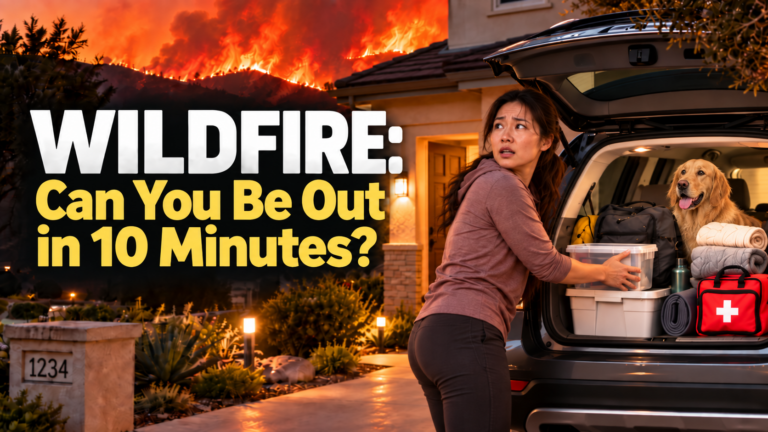
If You Had Only10 Minutes to Leave Your House, Would You Be Ready?
Ten minutes sounds like plenty of time—until you imagine using those minutes to find medications, locate a pet carrier, call a family member, grab identification, find your keys, decide where to go, and figure out which road is still open.
That is the real purpose of this question. It is not about becoming anxious about wildfire. It is about making as many decisions as possible before an emergency makes those decisions harder.
For wildfire preparedness, the goal should be simple: know how you will receive emergency information, know how you will leave, know where you will go, have essential items ready, and make sure everyone in your household—including pets—understands the plan. CAL FIRE currently recommends preparing a wildfire action plan, an emergency supply kit, and a family communication plan well before a wildfire threatens your area. (fire.ca.gov)
Written by Tony Babarino, Luxury Real Estate Broker and REALTOR® with REAL Broker, serving Irvine, Newport Beach, Newport Coast, and Orange County, CA. DRE#01717758.
For homeowners in Irvine and throughout Orange County, wildfire preparedness can be relevant even when fire is not at your front door. Wildfires can result in evacuation warnings, evacuation orders, changing road conditions, smoke, power interruptions, and emergency activity across a wider area. Local preparation matters because the safest route and instructions can change depending on the incident.
Key Takeaways
- Sign up for local emergency alerts before you need them. Orange County residents can register for AlertOC, the County’s emergency mass-notification system. (ocgov.com)
- Know at least two ways out of your neighborhood and discuss them with everyone in your household. Cal OES specifically recommends knowing two ways out. (news.caloes.ca.gov)
- Prepare a portable go-bag in advance with essentials such as water, food, medications, important documents, a flashlight, batteries, and phone charging capability. (news.caloes.ca.gov)
- Make a separate plan for pets, children, older adults, anyone with access or functional needs, and anyone who may require additional time to leave.
- An evacuation order is not the time to begin a ten-minute checklist. California describes an evacuation order as an immediate threat and a lawful direction to leave. Follow emergency officials and leave promptly. (news.caloes.ca.gov)
7 Things to Have Ready Before a Wildfire Evacuation
If you remember nothing else from this article, these are the seven things I would want a household to think through before an emergency:
- Emergency alerts — Make sure you are registered for local emergency notifications and know where official information will come from.
- At least two ways out — Know more than one possible route out of your neighborhood in case your normal road cannot be used.
- A family communication plan — Decide who everyone will contact and where you will meet if household members become separated.
- A ready-to-grab go-bag — Keep medications, identification, charging equipment, water, basic supplies, and household-specific necessities organized in advance.
- A pet evacuation plan — Know where the carriers, leashes, medications, food, identification, and other pet necessities are kept.
- A plan for anyone who needs extra time — Children, older adults, people with mobility or medical needs, people who do not drive, and households with multiple or large animals may need additional preparation or earlier action.
- A vehicle ready to leave — Think about fuel or charge level, maintenance, access to keys, and whether the vehicle can be used quickly if conditions change.
These seven items sound simple when nothing is happening. That is exactly the point.
The less you have to figure out during an emergency, the more attention you can give to the most important task: getting people safely out.
Important: The “10 minutes” in this article is a preparedness exercise. It is not a recommendation to remain at home for ten additional minutes after authorities tell you to evacuate. If an evacuation order is issued, follow the instructions of law enforcement and emergency officials.
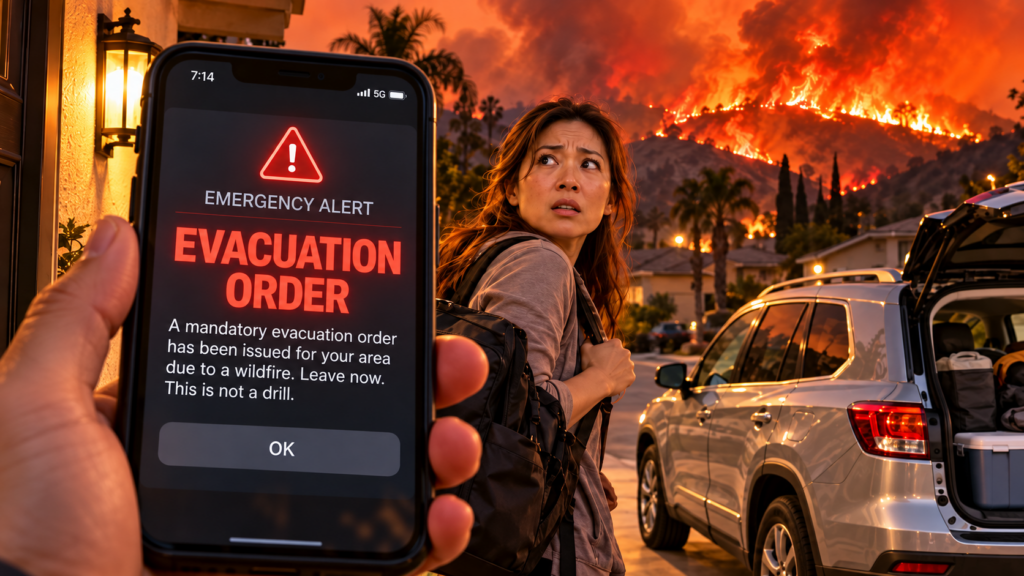
The Best Use of Those 10 Minutes May Be Before the Fire Ever Starts
Here is the question I would ask:
How many things on your evacuation list could be handled today instead of during an emergency?
Your medications cannot all be permanently packed away. Your family obviously cannot sit in the car waiting for wildfire season.
But many other decisions can be made beforehand.
You can already know:
- where the go-bags are;
- where pet carriers and leashes are;
- which medications need to come with you;
- where your important documents are stored;
- who is responsible for children or pets;
- where family members should meet if separated;
- whom everyone should contact;
- two or more possible ways out of the neighborhood; and
- where you may go if you need to leave the area.
That changes the situation from “What do we do?” to “We know the plan. Let’s go.”
And that may be one of the most valuable differences preparation can make.
Step 1: Make Sure Emergency Alerts Can Reach You
A plan is only useful if you know when conditions are changing.
Cal OES recommends signing up for local emergency alerts, and every California county offers an emergency-alert program. Orange County’s system is AlertOC, which can send time-sensitive emergency information through registered phone numbers, text messages, and email. (news.caloes.ca.gov)
For Orange County residents, this is one of the easiest preparedness steps to complete now rather than later.
You should also pay attention to instructions from local law enforcement, fire agencies, and emergency-management officials during an active incident. Conditions can change quickly, and a route that normally makes sense may not be the route authorities want people using during a particular emergency.
Do not assume that because you normally drive one way out of your neighborhood, that will automatically be the appropriate evacuation route.
Step 2: Know at Least Two Ways Out
Imagine pulling out of your neighborhood and discovering your normal route is closed.
Now what?
Cal OES’s July 2026 wildfire preparedness guidance recommends knowing at least two ways out of your neighborhood and practicing your evacuation plan before an emergency occurs. Orange County Fire Authority also recommends identifying several travel routes in case roads are blocked by fire or emergency vehicles. (news.caloes.ca.gov)
This does not mean trying to outsmart emergency officials or choosing your own route when authorities have provided specific directions.
It means being familiar with your area before something happens.
Know the major streets. Know the alternate exits. Know where those roads lead. If officials establish a specific evacuation route during an emergency, follow their instructions.
You should also decide ahead of time where you might go.
Possibilities could include the home of a friend or relative outside the affected area, an evacuation center or shelter announced by authorities, or another predetermined safe location.
Do not assume a particular shelter will always be open. The City of Irvine notes that shelter locations may depend on the particular emergency and advises residents to wait for official information about which facilities are open. (legacy.cityofirvine.org)
Step 3: Create Your Family Communication Plan
An evacuation can become much more complicated when everyone is not at home.
One person may be at work.
Children may be at school.
Someone may be running errands.
A family member may not answer the phone immediately.
CAL FIRE recommends completing a family communication plan that includes evacuation and contact information. (fire.ca.gov)
At minimum, everyone in the household should understand:
Who is our main contact?
Choose someone everyone knows to contact if the household becomes separated.
Where will we meet?
Choose a location outside the threatened area rather than simply saying, “We’ll meet at home.”
Who is responsible for whom?
Think about children, older family members, household members needing assistance, pets, and anyone who may require extra evacuation time.
What happens if cellular service is disrupted or someone cannot be reached?
The purpose of the plan is to reduce the number of decisions that must be made in real time.
Write the information down as well as storing it in your phones. A plan that exists only in one person’s memory is not much of a family plan.
Step 4: Prepare a Portable Go-Bag
There is an important difference between a full household disaster-supply kit and a portable evacuation bag.
Your go-bag should contain the items you are likely to need if you have to leave quickly.
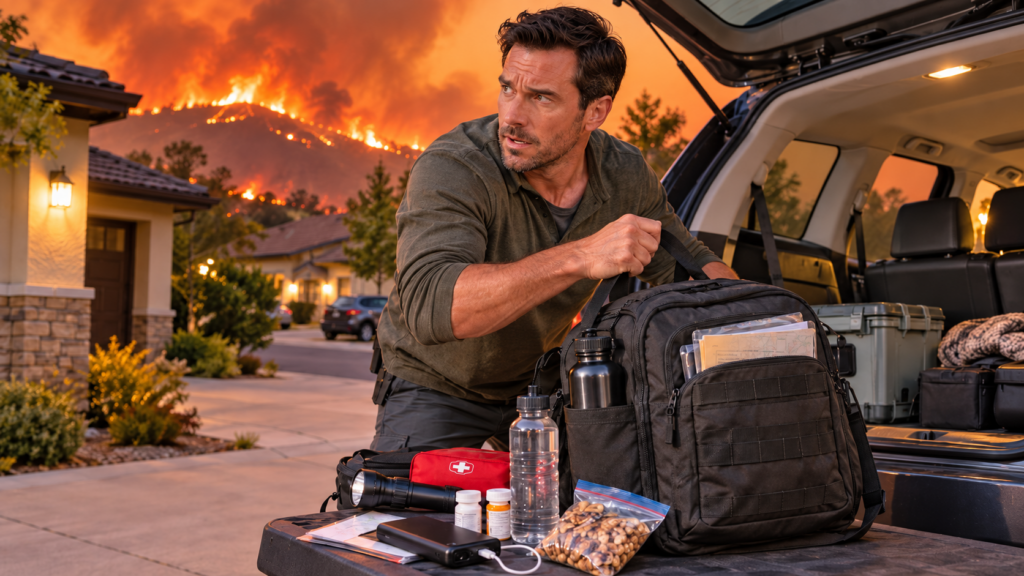
ReadyOC recommends preparing emergency supplies for home, work, and vehicles and notes that Orange County residents may need enough basic emergency supplies to be self-sufficient for several days. Its basic kit recommendations include water, nonperishable food, a flashlight, first-aid supplies, phone chargers, and necessary prescription medications. (readyoc.com)
For a wildfire evacuation bag, consider preparing items such as:
- identification and copies of important information;
- necessary medications and basic medical information;
- water;
- portable nonperishable food;
- phone charging cable and portable battery;
- flashlight and batteries;
- basic first-aid supplies;
- some cash;
- glasses or contact-lens supplies if needed;
- keys;
- basic clothing and personal-care necessities;
- pet supplies, when applicable; and
- emergency contact information.
The exact bag will be different for every household.
Someone with young children may need diapers, formula, or comfort items. Someone with a medical condition may have very different priorities. A pet owner may need food, medication, carriers, or veterinary information.
The point is not to create the world’s most complete backpack.
The point is to have the essentials already organized so you are not walking from room to room trying to build an emergency bag while conditions are getting worse.
Step 5: Have a Pet Evacuation Plan
Pets deserve their own evacuation plan, not simply a reminder at the bottom of yours.
CAL FIRE specifically tells residents to include pets in the household wildfire action plan and, when immediate evacuation becomes necessary, to locate pets and take them with them. (fire.ca.gov)
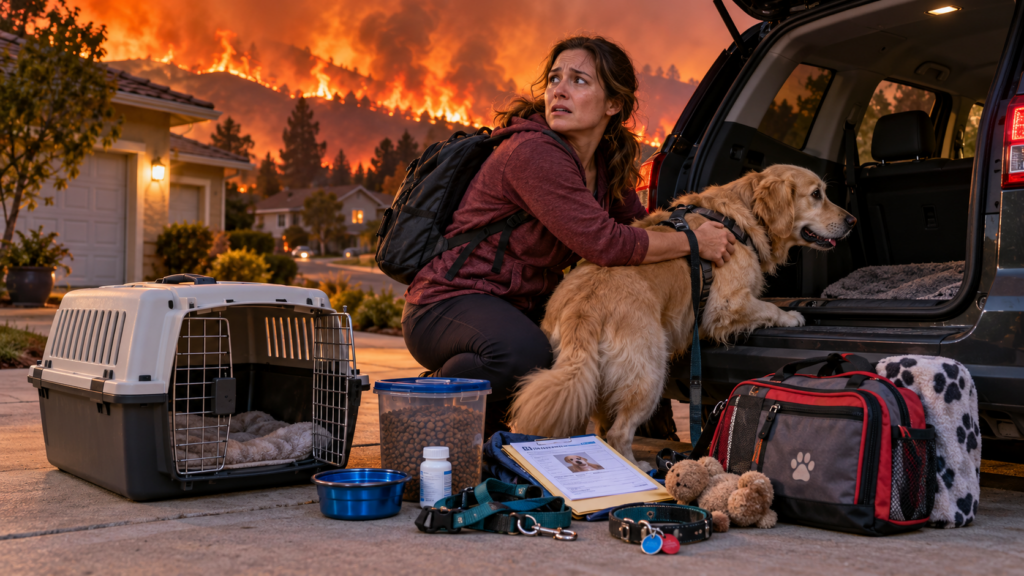
Think ahead about:
- carriers;
- leashes and harnesses;
- food and water;
- medications;
- vaccination and veterinary information;
- identification tags;
- waste supplies; and
- where your pet can stay if your normal destination does not allow animals.
This is particularly important for anyone with multiple animals or large animals, because evacuation may take additional time.
California’s evacuation guidance specifically encourages people who need extra time to leave—including those managing pets or livestock—to use an evacuation warning as a signal to prepare and, when appropriate, leave early. (news.caloes.ca.gov)
Step 6: Plan for Anyone Who May Need Extra Time
One of the biggest mistakes in emergency planning may be designing the plan around the fastest, most mobile person in the household.
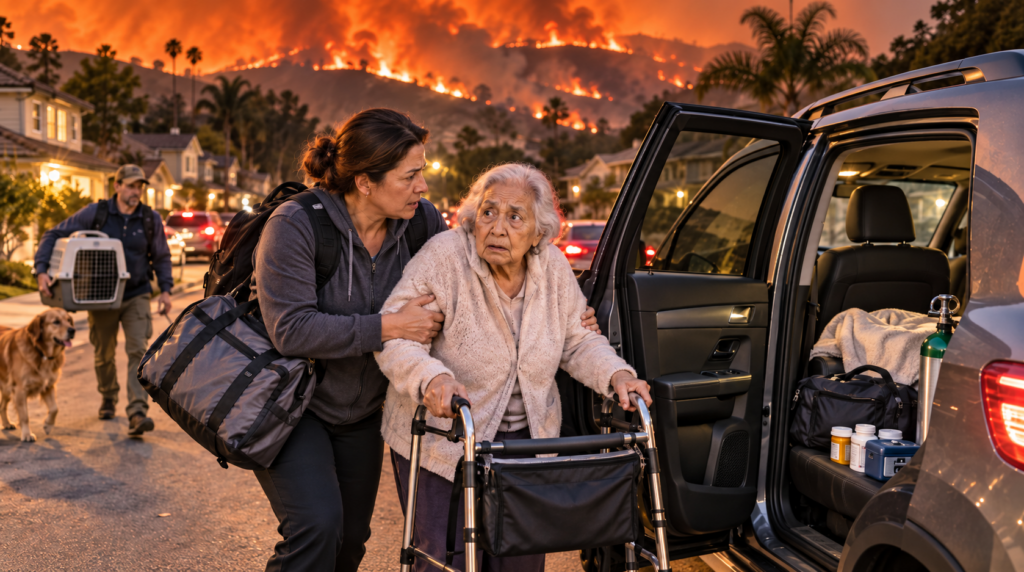
Instead, design it around the person—or animal—who may take the longest to evacuate safely.
That could mean:
- an older adult;
- someone using mobility equipment;
- someone who depends on medical equipment;
- a young child;
- a person who needs help understanding or responding to emergency instructions;
- someone who does not drive;
- multiple pets; or
- large animals.
An evacuation warning can be especially important for households needing additional time.
Cal OES describes an evacuation warning as a potential threat to life or property and advises people who need extra time to use that period to prepare or leave early rather than waiting until conditions become more urgent. (news.caloes.ca.gov)
Step 7: Keep Your Vehicle Ready to Leave
Your evacuation plan may be perfect until the car has a nearly empty fuel tank, the battery is dead, or the vehicle is buried behind things in the garage.
Current Cal OES wildfire guidance recommends keeping a vehicle fueled and adequately maintained during wildfire season so it can be used quickly if conditions change or an evacuation is ordered. (news.caloes.ca.gov)
This does not require keeping the vehicle prepared like an emergency-response truck.
It simply means thinking about the obvious problems before they become evacuation problems.
ReadyOC also recommends keeping emergency supplies in vehicles because a disaster may occur while you are away from home. (readyoc.com)
Know the Difference: Evacuation Warning vs. Evacuation Order
These terms matter.
| Term | What It Generally Means in California | What to Do |
|---|---|---|
| Evacuation Warning | There is a potential threat to life or property. | Prepare to leave. People who need additional time, including those with pets or livestock, should strongly consider leaving early according to official guidance. |
| Evacuation Order | There is an immediate threat to life. California describes this as a lawful order to leave, and the affected area is closed to public access. | Leave immediately and follow the directions of law enforcement and emergency personnel. |
| Shelter in Place | Authorities are directing people to remain indoors rather than evacuate. | Follow the specific instructions being issued for that incident. |
California uses standardized evacuation terminology, and emergency instructions should always take priority over a general checklist or blog article. (caloes.ca.gov)
If You Are Told to Leave, Your Priorities Change
Once an evacuation order is issued, the objective is no longer to complete your perfect checklist.
It is to leave safely.
Cal OES advises residents under an evacuation order to leave, follow directions from emergency personnel, use designated routes, watch for hazards, and not return for forgotten belongings until officials provide an all-clear. (news.caloes.ca.gov)
CAL FIRE similarly emphasizes having your evacuation bag ready beforehand and taking pets with you when immediate evacuation becomes necessary. (fire.ca.gov)
If there is time before an order and officials have not instructed you to leave immediately, some additional preparation may be appropriate. But no possession, photograph, document, or last-minute home task is worth delaying an urgent evacuation.
That is why preparation needs to happen on an ordinary Saturday—not when smoke is already visible from the neighborhood.
What About Important Papers, Insurance Information and Your Belongings?
Important documents deserve a place in your preparedness plan, but this is another area where advance preparation matters.
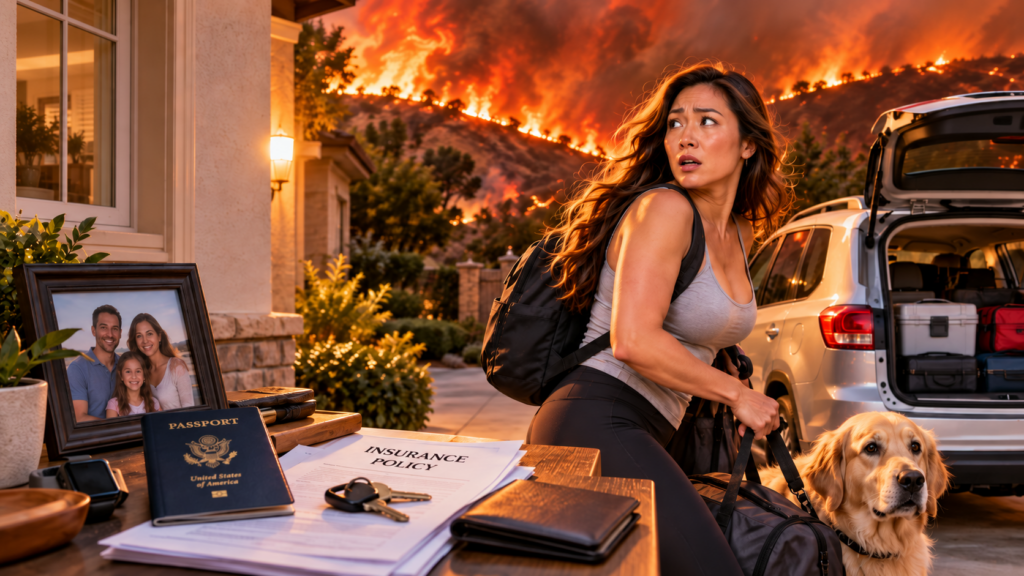
The California Department of Insurance recommends keeping insurance information accessible and, when time permits before evacuation, storing policy information electronically. It also recommends creating a photo or video home inventory before a loss occurs. (insurance.ca.gov)
That subject deserves more attention than a few paragraphs here.
In the next article in this wildfire series, I will cover:
What Should You Photograph Before a Wildfire?
That article will walk through a practical home-inventory process using a smartphone, what homeowners may want to document, and how to store the information so it is not lost with the house.
The important point for this article is simple:
Do the documentation before the emergency. Do not delay an urgent evacuation to document your belongings.
What This Means If You Are Thinking About Selling
Wildfire preparedness is primarily about protecting people—not selling real estate.
But fire-related questions can also come up during a home sale, particularly in areas where buyers may have questions about wildfire exposure, evacuation, insurance, defensible space, or fire-hazard designations.
The safest approach is not to make broad statements such as “this home is safe from wildfire” or to promise what an insurance company will or will not cover.
Fire conditions, hazard designations, insurance policies, disclosure obligations, and property circumstances can vary. When those questions matter in a transaction, sellers and buyers should rely on current official information, the actual property disclosures and reports, and the appropriate licensed professionals.
Later in this series, I will cover wildfire considerations specifically for buyers and sellers.
For now, the homeowner takeaway is much more personal:
Before worrying about how a future buyer may view wildfire risk, make sure your own household knows what it would do today.
Helpful Resources
CAL FIRE — Get Set: Wildfire Preparedness
Wildfire action plans, emergency kits and family communication planning.
CAL FIRE Get Set
CAL FIRE — Get Ready to Go
Current evacuation-preparation guidance.
CAL FIRE Get Ready to Go
California Governor’s Office of Emergency Services — Wildfire Preparedness
Current California guidance on alerts, evacuation routes, evacuation warnings and orders, go-bags and pets.
Cal OES Wildfire Preparedness
ReadyOC — Orange County Emergency Preparedness
Local Orange County emergency planning and emergency-kit information.
ReadyOC
AlertOC — Orange County Emergency Notifications
Orange County residents can register for local emergency alerts through AlertOC.
ReadyOC Alert Information
California Department of Insurance — Evacuation Checklist
Consumer information regarding documents, insurance and evacuation-related considerations.
California Department of Insurance Evacuation Checklist
Final Thoughts
You may never have exactly ten minutes.
You may have much more time.
You may have much less.
That uncertainty is exactly why the best time to figure out what you would do is when nothing is happening.
Sign up for alerts. Talk with your household. Know more than one way out. Prepare the bag. Plan for the pets. Think about the person who needs the most help. Decide where you would go.
You do not need to live in fear of wildfire to prepare intelligently for it.
You just need to make tomorrow’s emergency decisions a little easier by making some of them today.
If you are thinking about selling a home in Irvine, Newport Beach, Newport Coast, South Orange County, or nearby coastal Orange County, I would be happy to help you look at your home through a buyer’s eyes and talk through what may be worth addressing before you go on the market.
Tony Babarino
California Real Estate Broker | REALTOR®
REAL Broker
California DRE#01717758
TonyBabarino.com
Call/Text: (949) 633-6741

Disclaimer: This article is for general educational information only and is not legal, insurance, financial, emergency-response, fire-safety, medical, disclosure, or other professional advice. Wildfire conditions, evacuation instructions, routes, shelter locations, laws, insurance coverage, and government guidance can change and may vary by location and incident. During an emergency, always follow current directions from law enforcement, fire personnel, emergency-management officials, and other appropriate public-safety authorities. Do not delay an evacuation in order to complete a checklist, protect property, retrieve belongings, take photographs, or perform last-minute home-preparation tasks. For insurance, legal, medical, accessibility, animal-evacuation, or other specialized questions, consult the appropriate licensed or qualified professional. If your property is currently listed or you are already represented by another real estate broker, this is not intended as a solicitation.
FAQs About Wildfire Evacuation Preparedness
What is the difference between an evacuation warning and an evacuation order in California?
An evacuation warning generally means there is a potential threat to life or property and residents should prepare to leave. An evacuation order means there is an immediate threat to life and is a lawful direction to leave the affected area. Always follow current instructions from local authorities. (caloes.ca.gov)
Should I wait for an evacuation order before leaving?
Not necessarily. Cal OES advises people who require extra evacuation time, including those with pets or large animals, to consider leaving during an evacuation warning. If you believe you are in immediate danger, follow local emergency guidance and do not wait simply because an order has not yet reached you. (news.caloes.ca.gov)
How many evacuation routes should my family know?
Current Cal OES wildfire guidance recommends knowing at least two ways out of your neighborhood. During an actual incident, however, follow any specific routes or directions provided by emergency officials. (news.caloes.ca.gov)
What should I put in a wildfire go-bag?
A practical go-bag may include water, portable food, medications, identification and important information, phone charging equipment, a flashlight, basic first-aid supplies, necessary personal items and pet supplies. The contents should be adjusted for the needs of your household. (news.caloes.ca.gov)
Where can Irvine and Orange County residents sign up for emergency alerts?
Orange County operates AlertOC, a mass-notification system that can send emergency information through registered phones, text messages and email. Residents can register their contact information before an emergency occurs. (ocgov.com)
Should I return home if I forgot something during an evacuation?
No. Cal OES advises evacuees not to return for forgotten items and to wait until officials provide an all-clear before returning to an evacuated area. (news.caloes.ca.gov)
Want more Irvine real estate insights, helpful homeowner tips, and original videos in your Google experience? Add TonyBabarino.com as a Preferred Source.




Add comment